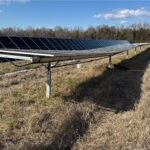
In the solar industry, we like to think of “utility-scale” as permanent. But the reality is that a solar array is only as stable as the soil it stands on. Lately, we’ve seen an uptick in potential clients reaching out with the same SOS: “Our piles are leaning, and we don’t know why.”
Why a “Band-Aid” is a Bad Investment
When an array starts to tilt or sink, the knee-jerk reaction is often to drive auxiliary piles or weld on extra braces to stabilize the movement. We recently reviewed a 10MW project where this was the proposed “fix.”
Our advice? Don’t do it. Adding more steel to a failing system without addressing the underlying issue is throwing good money after bad. If the original design didn’t account for the specific soil dynamics, you aren’t fixing the problem; you’re just delaying an inevitable and more expensive failure.
You can’t fix a leaning array by simply adding more steel to a bad design. We look below the surface at soil liquefaction and erosion to ensure the foundation outlasts the 25-year PPA.
Geotechnical Expertise: 40 States and 40 Different Problems
Having worked across 40+ states, we’ve seen every way the earth can reject a solar pile. Our remediation strategy isn’t “one size fits all” because the soil isn’t:
- Liquefaction: In seismic zones, “solid” ground can act like a liquid during an earthquake.
- Erosion & Scour: Water is the silent enemy. We’ve seen sites where the ground has simply washed away from under the piles.
Varying Soil Conditions: From the rocky terrain of the Northeast to the shifting sands of the Southwest, we adapt the engineering to the specific geography.
From the “Wall of Shame” to Professional Engineering
We’ve been in this game long enough to see the “wild west” era of solar construction. One of our favorite “Wall of Shame” examples dates back to 2011: an array where the installer couldn’t get a pile in deep enough, so they drove two more next to it and hand-welded everything together. It looked less like a power plant and more like a playground project gone wrong.
These “creative” field fixes are why we emphasize professional engineering. A solar site needs to perform for 25 to 35 years. You can’t achieve that with hand-welded “hacks” or “field-expedient” nightmares.
Our Approach to Remediation
- Site Assessment: We use forensic site assessments to determine if the failure is a design flaw, an installation error, or a geotechnical surprise.
- Engineering First: We propose a solution that addresses the soil-to-steel interaction, not just the visible lean.
- Future-Proofing: Whether it’s redesigning the pile depth or introducing specialized stabilization, our goal is to reset the clock on your asset’s lifespan.
Is your array looking a little slanted? Don’t wait for the next storm to see if your “band-aid” fix holds. Let’s get to the root of the problem and fix it for good.