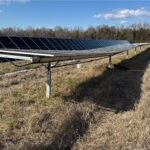
When a tornado rips through Oklahoma or a microburst hits Tucson, the immediate damage is obvious: twisted trackers and shattered glass. But for an asset owner, the real crisis begins 48 hours later.
As the dust settles, a race begins a race against the clock, the insurance adjuster, and the “invisible” mechanical failures that can plague a site for years if not caught immediately. At Sunformance, we specialize in forensic site assessments recovery that goes beyond just putting panels back on rails.
Rapid Response: Lessons from Oklahoma and Tucson
We’ve been on the ground following some of the industry’s most challenging “Acts of God.”
- The Tucson “Blackout” Storm: We managed a site where 30 trackers were lost because the site had no power during the storm. Without power, the trackers couldn’t move into their “stow” position (the defensive angle used to shed wind loads).
- The Oklahoma Tornadoes: We’ve seen how even the highest-rated racking can fail when subjected to the chaotic, multi-directional forces of a tornado during the construction phase.
In these moments, our role is two-fold: Stabilize the site to prevent further loss and document every inch for the insurance claim.
The ‘Shake Test’ and the North Carolina Warning
One of our most critical insights came from an array in North Carolina. A year after a major storm event, we found that nearly every connection on the site was loose.
This is the result of high-frequency vibration. During a storm, a solar array vibrates like a tuning fork. If the connections aren’t designed to a specific “Shake Test” (DIN EN 60068) standard vibration-resistant bolted joints), they will eventually back out.
“Post-disaster recovery is a race against the clock and the insurance adjuster. We don’t just put panels back; we perform ‘forensic’ recommissioning to find the loose connections that the storm or the original installer left behind.”
The ‘Human Factor’: Vehicle Impacts
Not every disaster is an “Act of God.” Sometimes, it’s the act of a distracted driver. From a truck driving into an array along the I-5 in California to similar impacts in New Jersey, we handle the “vehicle-vs-solar” repairs that require localized but highly technical structural work. These projects are unique because they often involve working with third-party liability insurance rather than standard property coverage.
Our Disaster Recovery Blueprint
- Site Safety: We perform an emergency “Log-Out/Tack-Out” to ensure the damaged sections aren’t energized or posing a fire risk.
- Forensic Recommissioning: We don’t just replace the broken parts. We re-torque every bolt and test every connection across the affected zone to ensure the vibration didn’t compromise the rest of the array.
- Insurance Advocacy: We provide technical reports that bridge the gap between what an insurance sees and what a solar engineer knows. We speak the language of “Root Cause” so your claim is handled accurately.
Has your site recently survived a storm? The connections might still be holding today, but are they vibrating loose for tomorrow? Let’s get a Sunformance team out for a post-event quality check.